By Avatar Yoga School | Last updated: October 2026
Yin yoga poses are slow, floor-based postures held for one to five minutes while your muscles stay soft. If your hips feel locked after long hours at a desk, or your mind won’t settle at night, this quiet style gives you a way to stretch deeply without effort or speed.
This guide covers 12 beginner-friendly yin yoga poses, with how to enter each one, how long to stay and which prop makes it easier. You’ll also find a pose table, a comparison of yin, restorative and hatha yoga, a 45-minute sequence, and an honest look at what research does and doesn’t show. Most poses need nothing more than a mat, a cushion and a folded blanket.
Key Takeaways
- Yin yoga is a slow style of yoga in which you hold passive, mostly seated or lying poses for about 1–5 minutes each.
- Beginners can start with holds of 1–3 minutes and build towards 3–5 minutes over a few weeks.
- Good first yin yoga poses include Butterfly, Child’s Pose, Sphinx, Dragon, Sleeping Swan and Bananasana.
- A 2018 randomised controlled trial in PLOS ONE found that five weeks of yin yoga reduced self-reported stress, anxiety and depression in stressed adults.
- You should feel a mild-to-moderate stretch, never sharp pain, tingling or numbness.
- People who are pregnant, hypermobile or recovering from injury or surgery should practise yin yoga only with medical advice and a qualified teacher.
This article is for general information and isn’t medical advice. Talk to your doctor before starting a new practice, especially if you are pregnant or have osteoporosis, joint replacements, a recent injury, or a back or knee condition.
What Is Yin Yoga?
Yin yoga is a slow, meditative style of yoga in which you hold passive floor poses for several minutes to apply gentle, sustained stress to the hips, spine and legs. Unlike active styles, you relax the muscles and let gravity and time do the work.
The name comes from the Taoist idea of yin and yang. Yang describes qualities that are active, warm and moving, like a vinyasa flow. Yin describes qualities that are still, cool and receptive. A yin class is the still half of that pair.
The practice draws on the work of martial artist Paulie Zink. Teachers Paul Grilley and Sarah Powers later developed it and gave it the name “yin yoga”. Many yin poses look like familiar hatha asanas (the Sanskrit word for posture) but have different names, because the intention is different. Pigeon Pose becomes Sleeping Swan, for example, because you rest in the shape instead of lifting your chest.
What Are the Benefits of Yin Yoga Poses?
Yin yoga poses may help reduce stress, improve how flexible you feel and give you a calm, structured way to slow down. Research on yin yoga specifically is still limited, so treat these benefits as promising rather than proven.
Here’s what the evidence suggests:
- Stress and mood: A randomised controlled trial led by researchers at Lund University, published in PLOS ONE in 2018, compared a five-week yin yoga programme, a yin yoga programme combined with mindfulness and a waiting-list control group in stressed adults. Both yoga groups reported lower stress, anxiety and depression than the control group.
- General wellbeing: According to the NIH’s National Center for Complementary and Integrative Health (NCCIH), yoga in general may help with stress management, sleep and some types of pain. These findings come from many yoga styles, not yin alone.
- Range of movement: Long, passive holds give the tissues around your joints time to adapt. Many people find this helps with stiff hips and a tight lower back.
A note on fascia: Fascia is the web of connective tissue that wraps and links your muscles, bones and organs. Yin teachers often say long holds “target fascia”. This makes physical sense, since connective tissue responds slowly to sustained load. Still, there is little direct research showing what yin yoga does to fascia, and scientists still debate even how to define the term. Treat fascia claims as a useful idea, not settled fact.
How Do You Practise a Yin Yoga Pose?
To practise a yin yoga pose, move slowly into a shape until you feel a moderate stretch, relax your muscles, stay still and hold it for 1–5 minutes. Paul Grilley describes three core principles: find your edge, become still, and hold for time.
Follow these steps for every pose:
- Enter slowly. Take about 30 seconds to ease into the shape.
- Find your edge. Stop at the point where you feel a clear stretch, roughly 5–6 out of 10 in intensity.
- Add props. Put a cushion, block or blanket wherever your body feels strained or unsupported.
- Soften your muscles. Let your belly, jaw and shoulders go. Breathe slowly through your nose.
- Stay still. Avoid fidgeting. If the sensation grows, back off slightly instead of pushing.
- Time your hold. Use a soft timer. Beginners can start with 1–3 minutes.
- Exit with care. Come out slowly and rest for 30–60 seconds before the next pose. The joints can feel stiff after a long hold.
12 Yin Yoga Poses for Beginners
1. Butterfly Pose
Sit with the soles of your feet together and your knees falling outwards. Slide your feet a little away from your hips, then fold forward with a rounded back. Butterfly pose in yin yoga stretches the inner thighs, hips and lower back. Put cushions under your knees if they float high.
2. Caterpillar Pose
Sit with your legs straight out in front and fold forward, letting your spine round. This stretches the hamstrings and the whole back of the body. Bend your knees over a rolled blanket if your hamstrings are tight.
3. Child’s Pose
Kneel, bring your big toes together and widen your knees. Fold forward and rest your forehead on the floor or a block. This is the most common resting pose between harder shapes.
4. Sphinx Pose
Lie on your belly and prop yourself on your forearms, elbows slightly ahead of your shoulders. Sphinx pose in yin yoga creates a gentle backbend in the lower spine. For a deeper version called Seal, straighten your arms. Skip Seal if your lower back pinches.
5. Dragon Pose
From all fours, step one foot forward between your hands and slide the back knee away. Lower your hips. Dragon pose in yin yoga opens the front of the back hip (the hip flexors), which tighten with long sitting. Pad the back knee with a blanket.
6. Sleeping Swan Pose
From all fours, bring one knee forward behind your wrist and lay the back leg straight behind you. Fold forward over the front leg. Sleeping Swan is a strong hip opener in yin yoga. Put a cushion under the front hip if it doesn’t reach the floor, and choose a gentler pose if you feel any knee pain.
7. Shoelace Pose
Sit and stack one knee over the other, with your feet beside your hips. Fold forward if that feels fine. This stretches the outer hips. If the stack is too much, sit on a block or straighten the bottom leg.
8. Dragonfly (Straddle)
Sit with your legs wide apart and fold forward with a soft spine. This stretches the inner thighs and hamstrings. Sit on a folded blanket to tilt your pelvis forward.
9. Bananasana
Lie on your back and shift both your feet and your upper body to the same side, so your body makes a gentle crescent shape. Bananasana pose stretches the side body, from the hip to the armpit. It’s one of the easiest lying poses for beginners.
10. Supine Twist (Twisted Roots)
Lie on your back, bend your knees and let them fall to one side. Keep both shoulders heavy on the floor. Put a cushion between or under your knees for support.
11. Happy Baby
Lie on your back and hold the outsides of your feet or your shins, with your knees bent towards your armpits. This releases the lower back and hips. Use a strap around the feet if you can’t reach them.
12. Savasana
Lie on your back with your arms and legs relaxed. Stay for 5–10 minutes at the end of practice. This final rest lets your nervous system settle after the long holds.
Yin Yoga Poses at a Glance
| Pose | Main Area | Beginner Hold | Experienced Hold | Helpful Prop |
|---|---|---|---|---|
| Butterfly | Inner thighs, lower back | 2–3 min | 4–5 min | Cushions under knees |
| Caterpillar | Hamstrings, spine | 2–3 min | 4–5 min | Rolled blanket under knees |
| Child’s Pose | Back, hips | 1–3 min | 3–5 min | Block under forehead |
| Sphinx | Lower spine | 1–2 min | 3–5 min | Folded blanket under hips |
| Dragon | Hip flexors | 1–2 min per side | 3–4 min per side | Blanket under back knee |
| Sleeping Swan | Outer hip, glutes | 1–2 min per side | 3–5 min per side | Cushion under front hip |
| Shoelace | Outer hips | 1–2 min per side | 3–4 min per side | Block under seat |
| Dragonfly | Inner thighs, hamstrings | 2–3 min | 4–5 min | Folded blanket under seat |
| Bananasana | Side body | 1–2 min per side | 3–4 min per side | None needed |
| Supine Twist | Spine, chest | 1–2 min per side | 3–4 min per side | Cushion under knees |
| Happy Baby | Lower back, hips | 1–2 min | 2–3 min | Strap |
| Savasana | Whole body | 5 min | 5–10 min | Blanket for warmth |
Yin Yoga vs Restorative Yoga vs Hatha: What’s the Difference?
Yin yoga uses long holds to create a gentle stretch, restorative yoga uses heavy prop support to relax without stretching, and hatha yoga uses shorter, active holds to build strength and alignment. Many people search for “restorative yoga poses” when they actually want yin, so it helps to know which one fits your goal.
| Feature | Yin Yoga | Restorative Yoga | Hatha Yoga |
|---|---|---|---|
| Main goal | Deep, passive stretch | Full relaxation and recovery | Strength, balance, alignment |
| Typical hold | 1–5 min | 5–20 min | 5 breaths to 1 min |
| Muscle effort | Relaxed | Fully relaxed | Active |
| Sensation | Mild to moderate stretch | Little or no stretch | Effort plus stretch |
| Props | Some | Many (bolsters, blankets) | Few |
| Best for | Tight hips, stiffness, calm focus | Fatigue, illness recovery, deep rest | Building a general foundation |
A 45-Minute Yin Yoga Sequence for Beginners
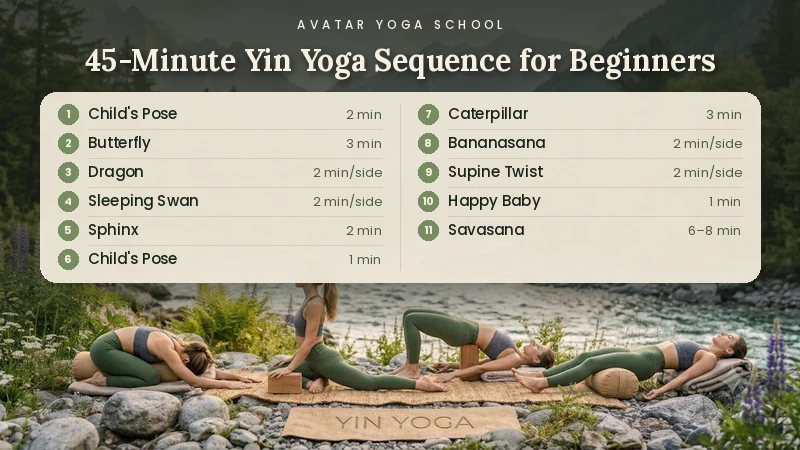
This 45-minute yin yoga sequence moves from the hips to the spine and ends in rest. Hold each pose for the beginner time in the table above and rest for 30 seconds between poses.
- Child’s Pose: 2 min
- Butterfly: 3 min
- Dragon: 2 min each side
- Sleeping Swan: 2 min each side
- Sphinx: 2 min
- Child’s Pose (counterpose): 1 min
- Caterpillar: 3 min
- Bananasana: 2 min each side
- Supine Twist: 2 min each side
- Happy Baby: 1 min
- Savasana: 6–8 min
Short on time? For a 15-minute version after a long flight or workday, do Child’s Pose, Dragon, Sphinx, Supine Twist and Savasana.
Who Should Try Yin Yoga Poses, and Who Should Be Careful?
Yin yoga suits most healthy adults who want a calmer practice, including beginners, desk workers, runners and people who already do active yoga. Some people need medical advice first.
Yin yoga is a good fit if you:
- Sit for long periods and feel stiff in the hips or lower back
- Do running, cycling or strong yoga and want a balancing practice
- Find it hard to switch off in the evening
- Want to learn stillness as a base for meditation
Be careful, and talk to a doctor first, if you:
- Are pregnant, because the hormone relaxin makes your ligaments looser
- Have hypermobility (very flexible joints), since deep holds can strain loose joints
- Have osteoporosis, which makes deep forward folds and twists riskier
- Have had a recent injury, surgery or joint replacement
- Have sciatica or disc problems in your back
The NCCIH advises that people with health conditions talk to their healthcare provider and work with a qualified teacher before starting yoga.
Common Mistakes to Avoid
- Pushing to your maximum. The aim is a moderate edge. Over time, a stretch at 9 out of 10 can irritate tissue instead of helping it.
- Ignoring warning signs. Sharp pain, burning, tingling or numbness means come out of the pose now.
- Skipping props. Props aren’t cheating. They let you stay longer with less strain.
- Fidgeting. Constant adjusting resets the stretch. Settle in, then stay.
- Coming out too fast. Exit slowly and take a counterpose, such as lying flat after Sphinx.
- Doing yin with no warmth. Practise in a warm room or wear layers, since cold muscles feel tighter.
How Avatar Yoga School Can Help

Avatar Yoga School in Swargashram, Rishikesh, a town in Uttarakhand, India, on the banks of the Ganga. The school was founded by Yogi Brajesh Sharma (known to students as Brajesh Ji), who teaches Hatha yoga. It has more than 12 years of teaching experience and has trained over 6,000 students from India, the US, the UK, Canada and other countries.
Avatar Yoga School offers a 50-hour Yin Yoga Teacher Training in Rishikesh, along with 100-, 200-, 300- and 500-hour Yoga Teacher Training courses, which the school lists as Yoga Alliance certified. If you want to learn without training as a teacher, the school also runs 7-, 10- and 14-day yoga retreats.
If you’d like a teacher to check your edge and props in person, or you want to teach yin yoga one day, see the 50-hour Yin Yoga Teacher Training in Rishikesh.
Frequently Asked Questions
How long should you hold yin yoga poses?
Most yin yoga poses are held for 3–5 minutes once you’re used to the practice. Beginners do well starting at 1–3 minutes and adding about 30 seconds each week. Some teachers hold poses for 7–10 minutes, but longer isn’t automatically better. A hold you can stay in calmly matters more than the number on your timer.
Can you do yin yoga every day?
Yes, many people practise a short yin session daily, often 15–30 minutes in the evening. If you practise every day, change which areas you focus on, for example hips one day and spine the next, and keep the intensity moderate. If a joint feels sore the next morning, shorten your holds or take a rest day.
Is yin yoga good before bed?
Yin yoga is a popular evening practice because it is slow, quiet and floor-based. Gentle poses like Child’s Pose, Supine Twist and legs resting up a wall suit bedtime. Avoid strong backbends right before sleep if they leave you feeling alert, and keep the room dim and warm.
Should yin yoga hurt?
No. Yin yoga should feel like a deep, steady stretch that you can breathe through, sometimes with mild discomfort. It should never cause sharp, stabbing or electric pain, or tingling and numbness in your arms or legs. These signs suggest pressure on a nerve or joint, so come out of the pose and try a gentler version.
Do you need props for yin yoga poses?
You don’t need special equipment to start. A firm cushion, a couple of folded blankets, a belt or scarf and some thick books can replace a bolster, blanket, strap and blocks. Props are useful because they let you relax in a pose for longer without straining.
Is yin yoga good for weight loss?
Yin yoga burns few calories because it is slow and passive. It isn’t an effective weight-loss workout. It can support a healthy routine by helping you manage stress and recover from active exercise, and pairs well with walking, strength training or faster yoga styles.
How do I become a yin yoga teacher?
Most yin yoga teachers first complete a foundational yoga teacher training, commonly 200 hours, and then add a specialist yin yoga training. Look for courses that cover anatomy, safe modifications and sequencing, and check that the school and lead teachers have recognised certifications. At Avatar Yoga School in Rishikesh, you can take the 200-hour Yoga Teacher Training and then the 50-hour Yin Yoga Teacher Training. The school lists its courses as Yoga Alliance certified.
Final Thoughts
Yin yoga poses offer a simple way to stretch deeply and slow down, using little more than the floor, a few cushions and some time. Start with two or three poses, such as Butterfly, Sphinx and Supine Twist, at 1–3 minutes each. Notice how your body responds over a couple of weeks before adding longer holds or stronger shapes like Dragon and Sleeping Swan. Stay at a moderate edge, use props freely and check with your doctor if you have a health condition. Practised this way, yin yoga becomes a calm, steady part of your week.