By Avatar Yoga School | Last updated: October 2026
Urdhva Hastasana is a standing yoga pose in which you reach both arms straight up over your head while your feet stay rooted. It looks simple, and it is. Still, the way you set your feet, ribs and shoulders decides whether it feels like a light, tall stretch or a strain in your neck and lower back.
This guide explains what Urdhva Hastasana means, how it differs from Hasta Uttanasana and Tadasana, and how to do it step by step. You’ll find alignment checks, breathing counts, easy variations for beginners, a comparison table and the cautions that matter. Everything here can be practised at home, on a mat or a bare floor, in about five minutes.
Key Takeaways
- Urdhva Hastasana, also called Upward Salute or Raised Hands Pose, is a standing pose in which you lift both arms overhead from Tadasana (Mountain Pose).
- The name comes from Sanskrit: urdhva means upward, hasta means hand and asana means posture.
- Hasta Uttanasana is the raised-arms step in Surya Namaskar and often adds a gentle backbend; Urdhva Hastasana usually keeps the spine long and upright.
- Inhale as you raise the arms and exhale as you lower them. Beginners can hold for 3–5 slow breaths.
- The two most common mistakes are flaring the front ribs forward and hunching the shoulders up towards the ears.
- People with a shoulder injury, vertigo or uncontrolled high blood pressure should modify the pose and check with a doctor first.
This article is for general information and isn’t medical advice. Talk to your doctor before starting a new practice, especially if you have a shoulder or neck injury, vertigo, high blood pressure or heart disease, or are pregnant.
What Is Urdhva Hastasana?
Urdhva Hastasana is a standing yoga posture in which you raise both arms overhead, palms facing each other, while keeping your feet grounded and your spine long. It is usually taught as a direct extension of Tadasana (Mountain Pose) and appears at the start of most standing practices and Sun Salutations.
Urdhva Hastasana meaning
In Sanskrit, urdhva means “upward”, hasta means “hand” and asana means “posture” or “seat”. Put together, Urdhva Hastasana means “upward hands posture”. In English classes you’ll hear it called Upward Salute, Raised Hands Pose or Upward Hands Pose.
Is Urdhva Hastasana the same as Hasta Uttanasana?
Hasta Uttanasana and Urdhva Hastasana are closely related, and many teachers use the names interchangeably. The usual difference is that Hasta Uttanasana, step 2 of Surya Namaskar, adds a gentle backward bend, while Urdhva Hastasana keeps the spine upright.
Uttana means “intense stretch”, so Hasta Uttanasana translates as “raised arms stretch” or “intensely stretched hands pose”. The NIOS textbook Physical Education and Yog, published by India’s National Institute of Open Schooling, describes it as the second position of Surya Namaskar: you raise both arms shoulder-width apart, inhale as they rise, and bend the head, arms and upper trunk back as far as is comfortable while you exhale. If you came here looking for Hastauttanasana information in English, that is the version most Indian school and Surya Namaskar texts mean.
Lineages name poses differently. What matters is whether you’re asked to stay upright or to arch back.
What Are the Benefits of Urdhva Hastasana?
Urdhva Hastasana may help you stretch the sides of the body, move the shoulders through their full overhead range and become more aware of your standing posture. There is no research studying this single pose on its own, so treat the benefits below as reasonable effects of the movement rather than proven outcomes.
Commonly reported hastasana benefits include:
- Shoulder mobility: Raising the arms overhead takes the shoulder joint through full flexion (lifting the arm forward and up). If you sit at a desk with your arms low all day, this is a range you may rarely use.
- Side-body length: Reaching up lengthens the muscles along the sides of the trunk, including the latissimus dorsi, the broad muscle that runs from the upper arm to the lower back.
- Posture awareness: Lining up feet, pelvis, ribs and head gives you a simple check of how you stand. The Ministry of AYUSH’s Common Yoga Protocol says its raised-arms version of Tadasana “brings stability in the body” and “corrects faulty posture”.
- Breath awareness: Because the arms rise with the inhale, you notice how the rib cage expands, a useful warm-up for pranayama (breath regulation).
On safety more broadly, the NIH’s National Center for Complementary and Integrative Health (NCCIH) states that yoga is “generally considered a safe form of physical activity for healthy people when practiced appropriately”. A 2015 systematic review in the American Journal of Epidemiology found yoga about as safe as usual care and exercise in the trials it examined.
How to Do Urdhva Hastasana: Step-by-Step
To do Urdhva Hastasana, stand in Tadasana, inhale and sweep your arms up until they’re overhead, keep your shoulders relaxed and ribs soft, hold for 3–5 breaths, then exhale and lower your arms. Follow these steps the first few times you practise.
- Stand in Tadasana. Place your feet hip-width apart, or with big toes touching if that feels steady. Spread your toes and feel weight evenly across both heels and the balls of your feet.
- Set your legs. Gently firm your thighs. Keep a micro-bend if your knees tend to lock.
- Find a neutral pelvis. Let your tailbone point down towards the floor rather than sticking your bottom out or tucking hard.
- Inhale and raise the arms. Sweep the arms out to the sides and up, or forward and up, taking about 3–4 seconds. Stop when your arms are overhead, roughly shoulder-width apart, palms facing each other.
- Relax the shoulders. Let your shoulder blades glide gently down your back while your arms stay reaching up. Your neck should feel long, not squeezed.
- Soften the front ribs. Draw your lower front ribs gently in so they don’t jut forward. This keeps the stretch in the shoulders and sides instead of the lower back.
- Set your gaze. Look straight ahead, or lift your eyes slightly towards your hands if your neck is comfortable. This gaze point is called drishti.
- Hold and breathe. Stay for 3–5 slow breaths at first. Over a few weeks you can build to 30 seconds.
- Exhale and release. Lower the arms slowly back to your sides and pause in Tadasana for one breath before moving on.
Urdhva Hastasana Alignment and Setup: What to Check
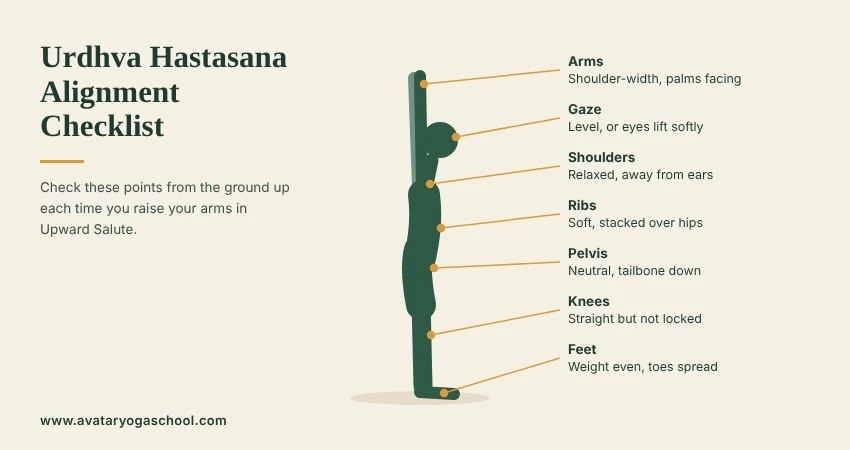
Good Urdhva Hastasana alignment means your weight is even through both feet, your pelvis is neutral, your ribs sit over your hips and your shoulders stay away from your ears. Use these quick self-checks, from the ground up.
| Body Part | What to Aim For | Simple Self-Check |
|---|---|---|
| Feet | Even weight on heels and balls of feet | Lift and spread your toes, then place them down |
| Knees | Straight but not locked | You could bend them a little without shifting weight |
| Pelvis | Neutral, tailbone pointing down | Hands on hip bones feel level, not tipped forward |
| Ribs | Stacked over the pelvis | Hand on lower ribs: they shouldn’t push forward as arms rise |
| Shoulders | Relaxed, blades sliding down | You can still see some space between shoulders and ears |
| Arms | Shoulder-width, palms facing | Elbows straight or softly bent; no strain |
| Head and neck | Long neck, chin level | Ears roughly in line with the upper arms, not jutting forward |
If you’re training to teach, the rib and shoulder checks are where most students need cues.
How Should You Breathe in Urdhva Hastasana?
Inhale through your nose as you raise your arms, breathe slowly and evenly while you hold, and exhale as you lower them. This pattern matches the guidance in both the Common Yoga Protocol and the NIOS textbook, which link the upward arm movement to inhalation.
For beginners, a count of about 4 seconds in and 4–6 seconds out works well. Let the breath widen the sides and back of your rib cage instead of lifting your shoulders.
Urdhva Hastasana vs Hasta Uttanasana vs Tadasana: What’s the Difference?

Urdhva Hastasana is an upright arms-overhead stretch, Hasta Uttanasana adds a gentle backbend within Surya Namaskar, and Tadasana in the Common Yoga Protocol adds interlaced fingers and a rise onto the toes. The table below sets out how they differ.
| Feature | Urdhva Hastasana | Hasta Uttanasana | Tadasana (Common Yoga Protocol, “Palm Tree”) | Tadasana (Mountain Pose, arms down) |
|---|---|---|---|---|
| English name | Upward Salute, Raised Hands Pose | Raised Arms Pose | Palm Tree Posture | Mountain Pose |
| Arms | Overhead, palms facing | Overhead, shoulder-width | Overhead, fingers interlocked, palms up | By your sides |
| Spine | Long and upright | Gentle backward bend | Long and upright | Long and upright |
| Feet | Flat | Flat | Heels lifted, balancing on toes | Flat |
| Breath | Inhale to lift | Inhale to lift, exhale to bend back (NIOS) | Inhale to lift | Steady, natural |
| Typical hold | 3–5 breaths | One breath within the flow | 10–30 seconds (CYP) | 5–10 breaths |
| Common use | Standing sequences, warm-ups | Surya Namaskar, steps 2 and 11 | Common Yoga Protocol, IDY sessions | Starting point for standing poses |
IDY: International Day of Yoga, held every year on 21 June.
Urdhva Hastasana in Yoga Sequences
Urdhva Hastasana usually appears early in a practice, between Tadasana and a standing forward fold, because it links breath and movement and prepares the body for bending. You’ll meet it in three main places.
- Surya Namaskar (Sun Salutation): In the Indian 12-step version, the raised-arms step comes second, after Pranamasana (prayer pose), and again near the end, before you return to standing.
- Standing warm-ups: Many hatha classes flow between Tadasana and Urdhva Hastasana 4–6 times, inhaling up and exhaling down, before holding any pose.
- Before balancing poses: Raising the arms is part of Vrikshasana (Tree Pose) in the Common Yoga Protocol, so practising Urdhva Hastasana first helps you feel steady with your arms overhead.
A short beginner flow: Tadasana → Urdhva Hastasana (5 breaths) → side bend each way (3 breaths) → forward fold with bent knees → roll up to Tadasana.
Urdhva Hastasana for Beginners: Easy Variations
Beginners can make Urdhva Hastasana easier by widening the arms, bending the elbows, practising against a wall or sitting on a chair. Choose the version that lets you breathe easily with relaxed shoulders.
- Wide “V” arms: Take the arms wider than your shoulders. This needs less shoulder mobility and helps if your shoulders feel tight.
- Cactus arms: Bend the elbows to about 90 degrees with palms facing forward. Useful if straight arms pinch the shoulder.
- Wall version: Stand with your back against a wall, heels about 10 cm away. Raise the arms only as far as you can while your lower back stays close to the wall. This is a clear way to see whether your ribs are flaring.
- Chair version: Sit tall on a firm chair and raise your arms. Good for balance concerns and desk breaks.
Beginner checklist: bare feet on a non-slip mat, room to reach up, loose clothing, a light stomach (about 2 hours after a big meal) and a strap or wall nearby if your shoulders are stiff.
Who Should Be Careful With This Pose?
Urdhva Hastasana is suitable for most healthy beginners, but people with shoulder injuries, vertigo, uncontrolled high blood pressure or heart conditions should modify it and speak to a doctor first. Pregnant practitioners can usually practise it with a wider stance and should follow their doctor’s guidance.
Take extra care, or choose a variation, if you have:
- A shoulder injury or frozen shoulder: Raise the arms only as high as is pain-free, or use cactus arms.
- Vertigo or balance problems: Stay with flat feet and avoid the rise onto the toes. The Common Yoga Protocol specifically advises avoiding lifting the heels if you have arthritis, varicose veins or vertigo.
- High blood pressure or heart disease: Keep holds short, breathe freely and lower your arms if you feel dizzy or breathless.
- Lower back pain: Skip the backbend version (Hasta Uttanasana) and focus on keeping the ribs soft.
- Pregnancy: Widen your feet for stability and avoid arching back.
The NCCIH advises practising under a qualified instructor to reduce the risk of injury, noting that learning yoga alone without supervision has been linked with higher risk.
Common Mistakes to Avoid
- Flaring the ribs. Tight shoulders make the lower back arch so the arms look higher. Draw the front ribs in, even if your arms stay slightly forward of your ears.
- Shrugging the shoulders. Reach up through the hands but let the shoulder blades slide down.
- Holding the breath. If you can’t breathe smoothly, lower the arms a little.
- Forcing the palms together. Pressing the palms together is a valid variation (Urdhva Namaskarasana in some traditions), but if it bends your elbows or lifts your shoulders, keep the hands apart.
- Throwing the head back. Dropping the head back to look up compresses the neck. Lift the eyes, not the chin.
How Avatar Yoga School Can Help
Avatar Yoga School is a yoga school in Swargashram, Rishikesh, a town in Uttarakhand, India, on the banks of the Ganga. It was founded by Yogi Brajesh Sharma (known to students as Brajesh Ji), who teaches Hatha yoga. The school has more than 12 years of teaching experience and has trained over 6,000 students.
In Hatha teacher training, foundational poses like Urdhva Hastasana and Tadasana are where alignment, breath and teaching cues are first learnt. Avatar Yoga School offers 100-, 200-, 300- and 500-hour Yoga Teacher Training courses, which the school lists as Yoga Alliance certified. If you’d rather practise without training to teach, the school also runs 7-, 10- and 14-day yoga retreats in Rishikesh.
New batches start on the 2nd of every month. If you’d like a teacher to check your Urdhva Hastasana alignment in person, a good place to begin is the 200-hour Yoga Teacher Training in Rishikesh, and you can see upcoming dates on the enrolment page.
Frequently Asked Questions
What is the English name for Urdhva Hastasana?
Urdhva Hastasana is usually called Upward Salute in English. You may also hear Raised Hands Pose or Upward Hands Pose. Some studios simply say “arms up from Mountain Pose”. All of these describe the same shape: standing tall with both arms reaching overhead, palms facing each other.
How long should you hold Urdhva Hastasana?
Beginners can hold Urdhva Hastasana for 3–5 slow breaths, which is about 15–30 seconds. Once your shoulders adapt, you can build to around a minute. In Surya Namaskar it’s held for just one inhale. Longer holds aren’t necessary; steady breathing and relaxed shoulders matter more than time.
Should your palms touch in Upward Salute?
Your palms can face each other with space between them, or touch overhead. Keeping them shoulder-width apart is easier on tight shoulders and is the usual starting point. Bring them together only if you can do it with straight elbows and relaxed shoulders. Both versions are correct.
Can I do Urdhva Hastasana every day?
Yes. Urdhva Hastasana is gentle enough for daily practice and suits short breaks during desk work. Three to five rounds, inhaling up and exhaling down, take under two minutes. If a shoulder feels sore the next day, reduce the height of your arms or take a day off.
Is Urdhva Hastasana good for posture?
Urdhva Hastasana may support better posture by making you aware of how your feet, pelvis, ribs and head line up. The Common Yoga Protocol says its raised-arms Tadasana helps correct faulty posture. No research has tested this pose alone, so it’s best seen as one helpful habit alongside strength work and regular movement.
Can I do Urdhva Hastasana if I have tight shoulders?
Yes, with a variation. Take your arms wider into a “V”, bend the elbows into cactus arms, or practise with your back against a wall. These options let you work within your current range. Stop if you feel sharp or pinching pain in the front or top of the shoulder.
What poses come before and after Urdhva Hastasana?
Tadasana usually comes before it, because Upward Salute starts from Mountain Pose. A standing forward fold (Uttanasana, or Padahastasana in Indian texts) often follows, as it does in Surya Namaskar. Side bends and Vrikshasana (Tree Pose) also pair well with it.
Final Thoughts
Urdhva Hastasana is one of the first poses most people learn. Done with care, it gives the shoulders a full reach and helps you match breath to movement. Start in a steady Tadasana, inhale as you lift, keep the ribs soft and the shoulders down, and stay for a few calm breaths. Use the wall or a wider stance whenever you need it. If you have a shoulder, neck or blood pressure concern, check with your doctor and practise Urdhva Hastasana under a qualified teacher.