
It’s 9 p.m. Your shoulders are up near your ears, your hips feel like concrete, and your mind is still answering emails from six hours ago. Sound familiar? I’ve had that evening more times than I’d like to admit. Early in my practice, I skipped anything that looked “too easy,” and Supta Baddha Konasana looked very easy. Lie down, bring your feet together, done. Then a teacher asked me to stay for ten minutes, and I finally understood. This pose isn’t easy. It’s quiet, and quiet is harder for most of us.
Here’s how to do it properly, who it suits, and how to adjust it so it feels kind to your body.
What Is Supta Baddha Konasana (Reclining Bound Angle Pose)?
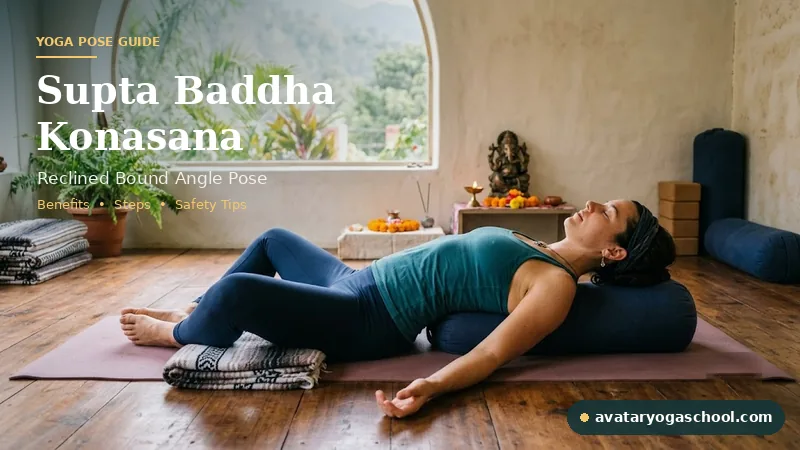
Quick answer: Supta Baddha Konasana, or Reclining Bound Angle Pose, is a restorative yoga posture where you lie on your back with the soles of your feet together and your knees falling open. It may help release hip and inner-thigh tension, slow your breathing, and support relaxation. Most people hold it for three to ten minutes.
The name is simpler than it looks. Supta means reclined, baddha means bound, kona means angle, and asana means pose. Your legs make a diamond shape, and your own feet do the “binding.”
You’ll also hear it called Reclining Butterfly in many studios. In Iyengar-style classes, it’s usually supported with bolsters and blankets, which is how I teach it.
How Do You Do Supta Baddha Konasana Step by Step?
Take your time here. This pose rewards patience, not effort.
- Place a bolster lengthwise behind you, with its short end touching your tailbone. No bolster? Two firm pillows or folded blankets work.
- Sit and bring the soles of your feet together. Let your knees fall open. Keep your heels about a foot away from your pelvis.
- Lean back on your hands, then lower your spine onto the bolster, one vertebra at a time.
- Slide a folded blanket under your head so your chin doesn’t tilt up toward the ceiling.
- Put a block or rolled blanket under each knee. Don’t skip this one.
- Rest your arms out to the sides, palms up, or place one hand on your belly.
- Close your eyes. Breathe in through your nose for about four counts and out for about six. Stay.
- To come out, press your hands into the floor, draw your knees together slowly, and roll onto your right side. Rest there for a few breaths before sitting up.
Who it suits: almost everyone who wants a gentle wind-down, including beginners, desk workers and anyone feeling stiff after a long day.
Which props make Supta Baddha Konasana more comfortable?
Props aren’t a sign you’re a beginner. I’ve watched people with fifteen years of practice finally melt into this pose only after adding blocks under their knees.
A basic setup is one bolster, two blocks, two blankets and, if you like, an eye pillow. A yoga strap looped around your lower back and feet can hold the legs in place so your muscles can stop working.
What Are the Benefits of Supta Baddha Konasana?
Here’s what many practitioners and students tell me they notice. These are experiences and traditional understandings, not guarantees.
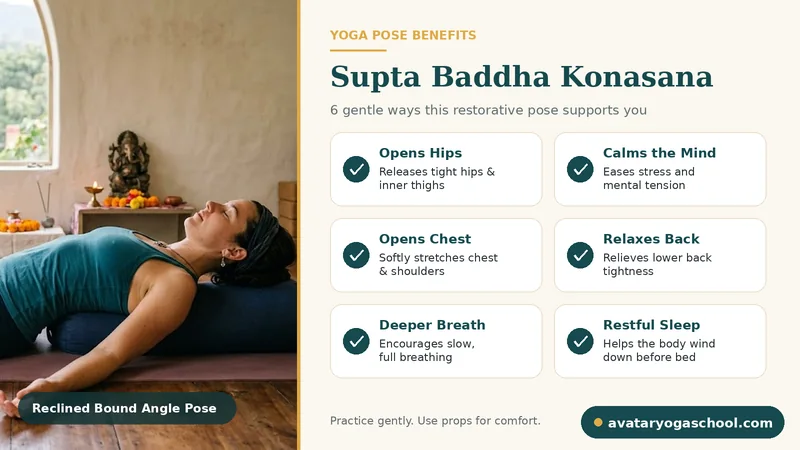
- Gentle hip opening. The inner thighs and groin lengthen passively, which may support mobility over time.
- A softer lower back. Many students find the supported position takes pressure off a tight lumbar area.
- Easier breathing. Lying over a bolster opens the chest and can encourage fuller, slower breaths.
- A calmer mind. The long exhale is a big part of why this pose feels settling. Many practitioners find it helps them switch off the “busy” mode.
- Relief after sitting. Hours in a chair, whether you’re in Bengaluru, Boston or Birmingham, tend to shorten the hip muscles. This pose offers a kind counter-position.
- A bedtime ritual. Several of my students use five minutes of it to wind down before sleep.
I’ll be honest, it won’t feel dramatic. The benefits of Supta Baddha Konasana show up quietly, like noticing you’re no longer clenching your jaw.
Which Supta Baddha Konasana Variations Suit Different Bodies?
Not every body wants the same shape. Here are the variations I use most in class.
What if your hips or knees feel tight?
Raise the support under your knees with thicker blocks or folded blankets until the inner thighs feel like they’re resting, not stretching. Bring your feet farther from your pelvis, too. A longer diamond is usually friendlier.
Can you use a strap to stay in the pose?
Yes. Make a loop with a strap and place it around your sacrum and over the tops of your feet. Adjust it until your legs feel held. This is my go-to for students who tire quickly or tend to grip.
Is there a flat-floor version without a bolster?
Absolutely. Lie flat on a mat with a folded blanket under your head and your knees supported by blocks or pillows. It’s less opening for the chest, but still calming.
Is there a more active version?
If you want something a little livelier, practise with your head and shoulders flat and gently rock your knees toward and away from each other on your exhales. Keep the movement small. It’s a nice warm-up before seated work.
Who Should Be Careful, and What Mistakes Do Students Make?
The most common mistake I see is forcing the knees toward the floor. Your knees don’t need to touch anything. If you feel a sharp pull in the groin or knee, add more support.
A few more I notice often:
- Arching the lower back. If your ribs flare up, tuck a folded blanket under your lower ribs or bring your feet farther away.
- Craning the neck. Your head should be supported so your throat stays soft.
- Holding your breath. It’s surprisingly common. Let the exhale be longer than the inhale.
- Rushing out. Give yourself a full minute of stillness at the end.
Safety note: Please talk to your doctor or physiotherapist before practising if you have a hip, knee, groin or sacroiliac joint injury, high blood pressure, or any medical condition. If you’re pregnant, ask your healthcare provider whether lying flat on your back is appropriate for you. In later pregnancy, many teachers prefer a semi-reclined position with a raised bolster. Always stop if something hurts.
Is Supta Baddha Konasana for Relaxation Worth Adding to Your Evening?
I think so, and here’s why. Most relaxation advice says “just relax,” which is useless when your body hasn’t got the memo.
This pose gives your body a clear job: lie here, let gravity do the work, and breathe slowly. There’s nothing to achieve.
One student of mine, a software engineer who always rushed through savasana, told me this was the first pose that made him feel “off duty.” He still uses it on weeknights, with a pillow and a phone left in another room.
Try this simple wind-down: dim the lights, set up your props, and place a hand on your belly. Breathe in for four, out for six, for about five minutes. If your mind wanders, which it will, just come back to the count. Mindfulness isn’t about stopping thoughts. It’s about noticing them and returning.
How Long Should You Hold It, and When Is the Best Time?
For beginners, I suggest two to three minutes. With practice, five to ten minutes feels wonderful. If your legs tingle or your lower back complains, come out and rest.
Good times to practise:
- Before bed, as part of a calm evening routine
- After a long day of sitting
- At the end of an asana class, before final relaxation
- On days when your energy feels low and you don’t want a full session
A few minutes daily usually helps more than one long session a week. Consistency is kinder to your body.
What Else Do People Ask About Reclining Bound Angle Pose?
Is Supta Baddha Konasana good for beginners?
Yes, it’s one of the friendlier poses for beginners when supported by props. Start with blocks under your knees and a folded blanket under your head. Hold for two or three minutes, and come out slowly. If anything feels sharp, add more support or skip the pose that day.
Can you do Supta Baddha Konasana every day?
Many people do, especially as an evening practice, because it’s gentle. Listen to your body, though. If your knees, hips or groin feel irritated the next day, use higher support or shorten the hold. Anyone with a medical condition should check with a doctor first.
Why do my knees hurt in Reclining Bound Angle Pose?
Usually the knees are dropping lower than your hips can comfortably allow, which puts strain on the joint. Raise the support under each knee, move your feet farther from your pelvis, and relax your effort. Sharp or lingering pain is a signal to stop and get advice.
What’s the difference between Baddha Konasana and Supta Baddha Konasana?
Baddha Konasana (Bound Angle Pose) is the seated version, where you sit upright with the soles of your feet together. Supta Baddha Konasana is the reclined version, usually supported by props. The reclined version tends to feel more restful and less demanding on the spine.
Ready to Practice Supta Baddha Konasana With a Teacher by Your Side?
If you’ve read this far, you’re probably tired in the best, most human way. Try Supta Baddha Konasana tonight. Three minutes, a pillow, and a slow breath. If you’d like guidance on your props, alignment and pacing, join one of our online classes at avataryogaschool, or book a free trial session. Whether you’re practising from India, the US or the UK, we’ll meet you where you are. Be gentle with yourself. You’ve earned the rest.