You wrap your arms, you wrap your legs, you wobble, and suddenly you’re hopping on one foot like you’re trying to catch a bus. Sound familiar? I’ve watched that exact scene in my classes for over ten years. And honestly, I lived it myself. For my first two years of practice, I quietly skipped Garudasana whenever the teacher wasn’t looking at me.
Here’s the good news. Once you understand what the pose is actually asking for, it gets far less scary.
Quick Answer: What Is Garudasana?
Garudasana, or Eagle Pose, is a standing balance pose where you wrap one leg and one arm around the other while bending the standing knee. Many practitioners find it supports balance, focus, and mobility in the shoulders, hips and legs. Beginners can practise it near a wall.
Garudasana Meaning and Symbolism
- Garuda is the Sanskrit word for eagle, and asana means pose or seat. So Garudasana is simply Eagle Pose.
- But Garuda is more than a bird. In Indian tradition, Garuda is the great eagle who serves as the vehicle of Lord Vishnu. He represents strength, vigilance, and the ability to see clearly from a height.
- I like to remind students of this when they’re shaking in the pose. An eagle doesn’t flap about when it’s focused. It grips, it settles, it watches. That’s the feeling we’re borrowing here.
- The shape of the pose carries the symbolism too. Your limbs wrap tightly in toward your centre, like a bird gathering itself before it moves. Your gaze stays fixed on one point. Your mind has no room to wander, and that’s half the point.
Eagle Pose Benefits: What Practitioners Notice
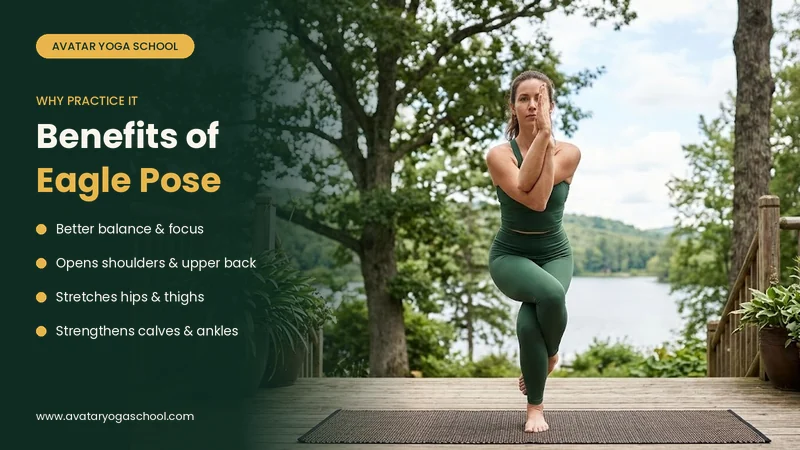
Let me be straight with you. Yoga isn’t a cure for anything, and I won’t pretend Garudasana is. But after years of teaching it, I see the same positive things come up again and again. Many practitioners find Eagle Pose may help with:
- Balance and steadiness. Standing on one leg with a bent knee asks your ankle, knee and hip to work together.
- Focus. You can’t scroll through your to-do list while balancing. The pose pulls your attention in.
- Shoulder mobility. The arm wrap stretches the upper back and the area around the shoulder blades.
- Hip and thigh engagement. The wrapped leg opens the outer hip, while the standing leg gets a real workout.
- Ankle and calf strength. Small stabilising muscles wake up quickly here.
- Calm breathing. Slow, steady breath is the only way to stay in the pose for long.
Some students also tell me it helps them feel less tight after long hours at a desk. That’s a personal report, not a promise, but it’s one I hear often from my office-going students.
Garudasana Benefits for Shoulders and Legs
- Let’s get a little more specific, because this is what most people want to know.
- For the shoulders, the cross-arm position gently stretches the rear shoulder muscles and the upper back. If you carry tension from typing or driving, you’ll probably feel it right between the shoulder blades.
- For the legs, the standing side builds strength in the quadriceps, glutes and calves. The wrapped side stretches the outer hip and the muscles around the thigh. Both sides learn to cooperate, which is why the pose feels so awkward at first.
How to Do Garudasana Step by Step
Take your time with this. Read it once, then try it slowly. I’d suggest practising near a wall for your first few rounds.
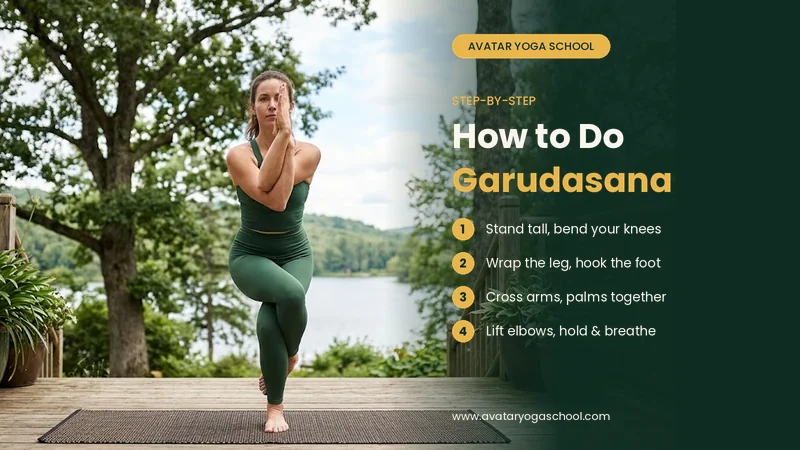
- Start in Mountain Pose (Tadasana). Stand tall, feet together or hip-width apart, weight evenly spread.
- Bend both knees slightly and sink your hips back, as if you’re sitting on a low stool.
- Shift your weight into your left foot. Lift your right foot off the floor.
- Cross the right thigh over the left. Aim to hook your right foot behind your left calf. If that’s too much, rest the right toes on the floor or a block.
- Extend your arms in front of you. Cross your left arm under your right at the elbows.
- Bend the elbows and wrap the forearms. Try to bring your palms together. If they don’t meet, hold opposite shoulders or just press the backs of the hands together.
- Lift your elbows to shoulder height. Keep your shoulders relaxed and away from your ears.
- Fix your gaze on one steady point and breathe slowly for 5 to 8 breaths.
- Release gently, then repeat on the other side.
Who It Suits?
- Garudasana suits most healthy adults who want to work on balance, focus and mobility. It’s also a nice pose for people who sit for long hours, as long as they go slowly.
- One Common Mistake
- The biggest mistake I see is leaning forward and gripping everything tight. Students clench the jaw, hunch the shoulders, and hold their breath. Keep your spine long, let your tailbone drop, and soften your face. Tightness makes balance harder, not easier.
Garudasana for Balance and Flexibility
- Here’s something I tell every new student. Balance isn’t a gift you either have or don’t. It’s a skill, and it responds to practice.
- Garudasana is a wonderful teacher for this because it removes your usual crutches. You can’t lean on your arms or spread your feet wide. You have to find your centre.
- For flexibility, the pose works in two directions at once. The arm wrap opens the upper back and shoulders, while the leg wrap works the outer hips. Neither stretch is extreme, which is why the pose is friendly if you’re patient.
A few things help your balance right away:
- Pick a spot on the floor or a wall and stare at it softly.
- Keep the standing knee bent, not locked.
- Draw your belly in slightly, like zipping up a jacket.
- Breathe through your nose, slowly.
And if you fall out? Laugh, reset, try again. I still wobble on tired days, and I’ve been teaching for a decade.
Eagle Pose Yoga for Beginners
If you’re new, the full pose can look impossible. It isn’t, but it does need modifications. Here are the ones I teach most often.
- Use a wall. Stand beside a wall and lightly touch it with your fingertips while you find your balance.
- Keep the toes down. Instead of hooking the foot behind the calf, cross the thigh and rest the toes on the floor. This is still Garudasana, and it’s perfectly valid.
- Try Eagle arms only. Sit in a chair and practise the arm wrap by itself. It’s a great way to loosen the shoulders first.
- Use a block. Rest the lifted foot’s toes on a block for a bit of stability.
- Don’t force the palms together. Many beginners have tight shoulders. Holding opposite shoulders, like a hug, works just as well.
- I remember a student in her sixties who came to my class convinced she’d never manage this pose. She started with the wall and the toes-down variation. A few months later, she was hooking her foot all the way around. She did it by being patient, not by being flexible.
- How Long Should Beginners Hold It?
- Start with 3 to 5 breaths per side. Add a breath or two each week. Short and steady beats long and shaky.
Common Mistakes and How to Fix Them
Over the years I’ve noticed a few patterns. Here’s what to watch for.
- Holding the breath. If you can’t breathe easily, you’ve gone too far. Ease off.
- Locking the standing knee. Keep it soft and bent. This protects the joint.
- Collapsing the chest. Lift through the crown of your head and keep the ribs open.
- Rushing the wrap. Take a moment to set each limb before adding the next.
- Comparing yourself. Your Eagle will look different from the person on the next mat, and that’s fine.
Safety Note
Please talk to your doctor before starting if you have a knee, ankle, hip or shoulder injury, an inner ear or balance issue, high or low blood pressure, or if you’re pregnant. Practise near a wall, and stop if you feel sharp pain or dizziness. Yoga should feel challenging, never painful.
FAQ: Garudasana Questions People Ask
What does Garudasana mean?
Garudasana comes from the Sanskrit words Garuda, meaning eagle, and asana, meaning pose. In Indian tradition, Garuda is the mighty eagle who carries Lord Vishnu. The pose is often linked with focus, strength and clear vision, which is why it’s practised with a steady gaze.
What are the main benefits of Eagle Pose?
Many practitioners find Eagle Pose may support balance, concentration, and mobility in the shoulders, hips and legs. It also asks you to breathe steadily, which can feel calming. The results are individual and the pose is best used as an addition to a regular balanced practice.
Is Garudasana good for beginners?
Yes, with modifications. Beginners can practise near a wall, keep the lifted foot’s toes on the floor, and hold opposite shoulders instead of bringing the palms together. Start with a few breaths per side and build slowly. If you have any injuries, check with your doctor first.
Why is Eagle Pose so hard for balance?
Because it shrinks your base of support and wraps your limbs close together. You can’t use your arms or a wide stance to catch yourself. Fixing your gaze, bending the standing knee, and engaging your core can help. Don’t worry if you wobble, since that’s how balance improves.
How long should I hold Garudasana?
Beginners can hold it for 3 to 5 breaths per side. With practice, many people work up to 8 to 10 breaths. Quality matters more than time. If your breathing gets strained or your form falls apart, come out gently and rest.
Final Thoughts on Garudasana
Garudasana won’t feel graceful on day one. Mine certainly didn’t. But with a wall nearby, a soft gaze, and a little patience, the pose slowly turns from a wobbly puzzle into something steady and quietly powerful.Keep going, be kind to yourself, and let the eagle in you settle in at its own pace.
If you’d like a teacher to guide you through Garudasana and other balance poses, join a free trial class at Avatar Yoga School. We’d love to practise with you, wherever you are in India, the US or the UK.