
It’s 11 pm. Your body is exhausted, but your mind is replaying something you said at lunch. मन शांत होने का नाम ही नहीं लेता, है ना?
I’ve taught yoga for more than ten years, and this is the complaint I hear most. A student in my evening class once told me she’d tried herbal tea, a new pillow and a sleep app. What finally softened her nights was ten quiet minutes on Monday evenings, chanting the Chandra mantra.
I was sceptical too, honestly. Then I tried it for a month, and I stopped being sceptical.
Quick answer: The Chandra mantra is a Sanskrit chant offered to Chandra, the Moon in Vedic tradition. The simplest form is “Om Chandraya Namah” (ॐ चन्द्राय नमः). Many practitioners chant it 108 times, often on Monday evenings, to feel calmer and more emotionally steady. It’s free, gentle and needs nothing but a quiet seat.
What Does Chandra Mean in Yoga Tradition?
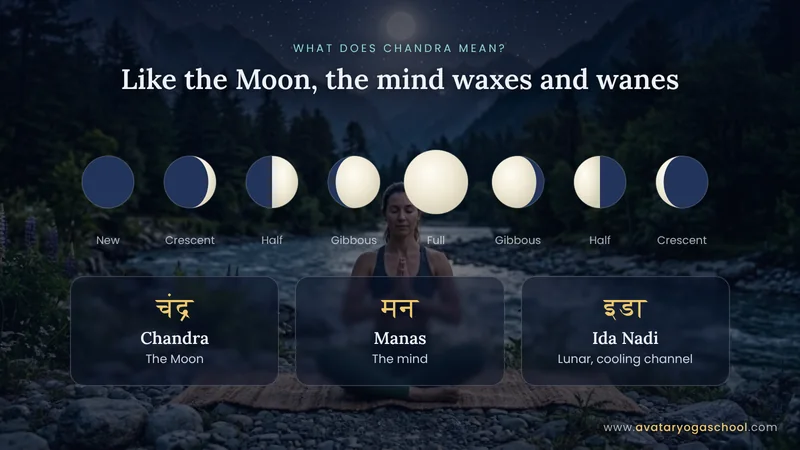
Chandra (चंद्र) is the Sanskrit word for the Moon. In Vedic thought, it’s also the name of a deity linked with the mind, or manas (मन). That’s the part that matters on the mat.
Think about how the Moon behaves. It grows, it fades, it pulls the tides. Our moods do something similar. Some days you feel full and bright. Other days you feel thin and flat for no clear reason.
Hatha texts describe ida nadi, the left subtle channel, as lunar and cooling. That’s one reason moon practices pair nicely with slow breathing and evening poses.
And a mantra isn’t a spell. The word is often explained as a tool for the mind. You repeat a sound until the mind has something steady to hold. The Chandra mantra simply uses the Moon as that focus.
Which Chandra Mantra Is Right for You?
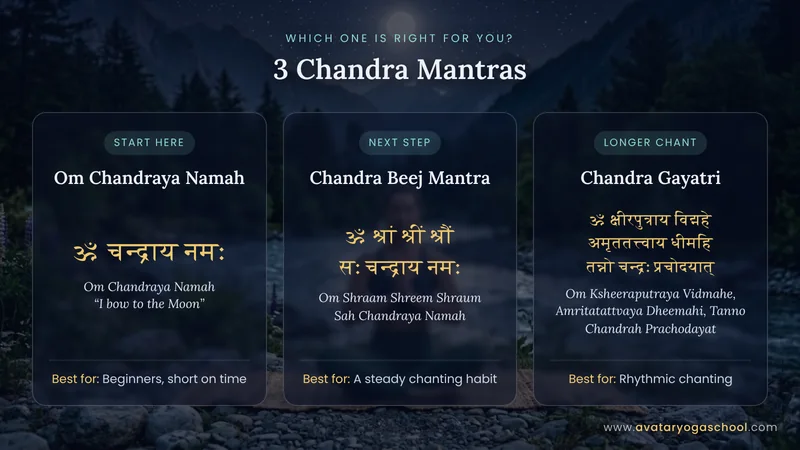
There are three versions I teach most often. Start with the first, and let the others come later.
Om Chandraya Namah (ॐ चन्द्राय नमः)
This is the classic. It means roughly “I bow to the Moon.” Say it as Om chan-DRAH-yah na-MAH-ha, slowly. Let the “Om” begin with an open “aa” and close with a hum.
It suits beginners and anyone short on time. The common mistake? Racing through 108 repetitions like you’re clearing an inbox. Slow down. जल्दबाज़ी नहीं, ध्यान से। Ten calm rounds beat a rushed mala.
Chandra Beej Mantra (चंद्र बीज मंत्र)
ॐ श्रां श्रीं श्रौं सः चन्द्राय नमः
In English letters: “Om Shraam Shreem Shraum Sah Chandraya Namah.” Some books end it with Chandramase Namah, so follow your teacher’s version. Beej means seed, and these seed syllables are traditionally said to carry the Moon’s quality in concentrated form.
It suits students who already hold a steady chanting habit. Most people flatten the vowels. Let “Shraam” be long and open, and let “Shreem” ring in the front of the mouth.
Chandra Gayatri Mantra (चंद्र गायत्री मंत्र)
ॐ क्षीरपुत्राय विद्महे अमृततत्त्वाय धीमहि तन्नो चन्द्रः प्रचोदयात्॥
Roughly, it asks us to meditate on the Moon, born of the milky ocean and nectar-like in nature, and to let that light guide our thinking. Wording varies slightly between lineages.
It suits people who enjoy longer, rhythmic chants. The mistake here is learning only from text. Listen to a teacher first, then copy the rhythm.
How Can a Moon Mantra for Emotional Balance Help?
Here’s where I’m careful. Chandra Mantra isn’t medicine, and I won’t promise it fixes anything. What I can say is what I’ve seen in classes and in my own practice.
Chanting slows your exhale. A long exhale tends to settle the body, and a settled body makes it easier for the mind to follow. Repeating one sound also gives your attention a single job, which is a gentle form of mindfulness. General research on meditation and mantra repetition suggests benefits for perceived stress, though results vary.
Many practitioners say regular chanting can support:
- A calmer evening wind-down
- Steadier focus during the day
- More patience with their own moods
- A simple ritual that makes the week feel anchored
My student, the one with the 11 pm mind, didn’t stop having busy thoughts. She just stopped believing every one of them. That’s what I mean by emotional balance. विचार रुकते नहीं, बस उनकी पकड़ ढीली हो जाती है. A bit more room to breathe between feeling and reacting.
Which Gentle Poses Prepare Your Body for Chanting?
Mantra works best when your body isn’t fighting you. I like to spend five minutes on one of these first.
Easy Pose (Sukhasana). Sit on a folded blanket so your hips sit higher than your knees. It suits most beginners. The usual mistake is slumping into the lower back, so lift your chest gently and relax your shoulders.
Reclining Bound Angle Pose (Supta Baddha Konasana). Lie back with the soles of your feet together and support your knees with cushions. It suits tight hips and tired days. Many students let the knees hang unsupported, which strains the groin, so prop them well.
Legs-Up-the-Wall Pose (Viparita Karani). Rest your legs against a wall for a few minutes with slow breathing. It suits evening practice. The mistake is sitting so far from the wall that your legs strain, so shuffle closer.
How Do You Chant Chandra Mantra Step by Step?
Here’s the routine I give new students. It takes about fifteen minutes.
- Pick your mantra. Begin with Om Chandraya Namah.
- Find a quiet seat. Sit cross-legged on a cushion, or on a chair with your feet flat. Keep your spine tall but not stiff.
- Settle your breath. Take five slow breaths, lengthening each exhale.
- Set your count. Use a 108-bead mala (माला), or count rounds on your fingers. Start with 27 or 54 and build toward 108.
- Chant aloud first. Say it slowly, one repetition per exhale.
- Move to a whisper, then silence. Let the sound fade inward and repeat it mentally. Notice the vibration in your chest and jaw.
- Sit in stillness. Stay for two minutes after the last bead. Don’t rush to your phone.
I used to chant at double speed and wonder why I felt wired afterwards. Slowing down changed everything. And if sitting on the floor hurts, chant on a chair. The mantra doesn’t care where you sit.
When Is the Best Time to Practise Chandra Mantra?
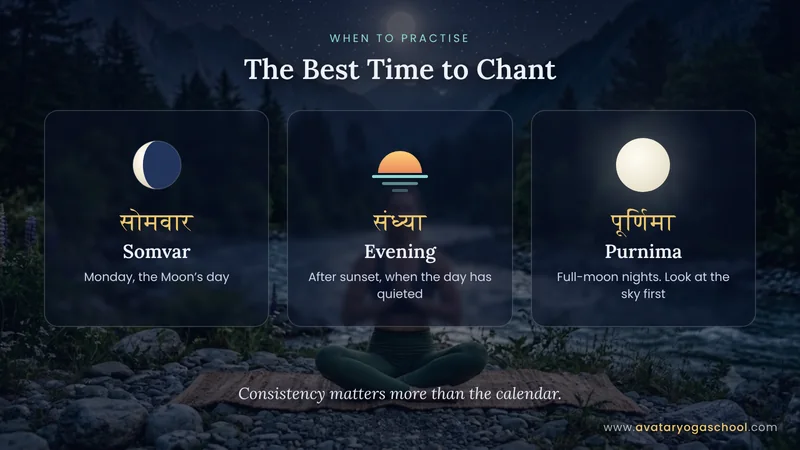
Traditionally, Monday is Somvar (सोमवार), the Moon’s day, so many practitioners chant then. Evening works well too, ideally after sunset when the day has quieted. Some people also like full-moon nights (पूर्णिमा). If you do, step outside and look at the sky for a minute first.
Honestly, though, consistency matters more than the calendar. Chanting for ten minutes on a Wednesday you actually show up for beats a perfect Monday you skip.
Some traditions suggest chanting daily for forty days to settle a new habit. Try it if that appeals, but don’t treat it as an exam.
What Is Chandra Graha Shanti?
In Vedic astrology, graha means planet and shanti means peace. Chandra graha shanti (चंद्र ग्रह शांति) is the set of remedies traditionally suggested when the Moon is considered weak or troubled in a birth chart. These often include mantra chanting, charity, and offerings of white foods or flowers on Mondays.
I’m a yoga teacher, not an astrologer, so I won’t read your chart here. Treat astrology as a cultural and personal belief practice, and please don’t make health, money or relationship decisions based on it.
Here’s the useful part, though. You don’t need a kundali to benefit from the mantra. As a meditation practice, it stands on its own.
What Mistakes Should You Avoid in Chandra Mantra?
After years of watching students chant, these three come up again and again:
- Forcing the volume. Chanting should feel resonant, not strained.
- Chasing the count. Losing your place isn’t failure. Just return to the next bead.
- Expecting a result by Thursday. Some evenings you’ll feel calm. Some evenings you’ll feel nothing. Both count.
A short safety note: if you have an injury, are pregnant, or live with a medical or mental health condition, check with your doctor before adding new breathing or sitting practices. If low mood or anxiety feels heavy or lasts for weeks, please speak with a qualified professional. Mantra can sit alongside care. It shouldn’t replace it.
What Else Do People Ask About Chanting to the Moon?
Can beginners chant the Chandra mantra?
Yes, many people repeat it mentally while lying down. Keep the breath slow and let the repetition drift. If you notice you’re getting wired or frustrated, stop and simply rest. The aim is softness, not another task to complete before sleep.
How many times should you chant Chandra Mantra?
Traditionally, 108 is the number used, matching the beads on a mala. Beginners can start with 27 or 54 and build up. Some traditions prescribe much larger counts over set periods, but a smaller daily practice you can keep is more useful than a big one you abandon.
What does the Chandra Beej mantra mean?
Beej means seed. The beej mantra packs the Moon’s qualities into short seed sounds that are chanted for focus and calm. The syllables are meant to be felt as vibration rather than translated word by word, which is why teachers stress sound and rhythm.
Is it okay to chant silently before sleep?
Yes, many people repeat it mentally while lying down. Keep the breath slow and let the repetition drift. If you notice you’re getting wired or frustrated, stop and simply rest. The aim is softness, not another task to complete before sleep.
Do you need to be Hindu to chant Chandra Mantra?
No. Mantra practice comes from the Vedic and yogic traditions, and many people of different backgrounds use it as a meditation tool. What matters is respect: learn the meaning, pronounce it with care, and approach it as a sincere practice rather than a trend.
Where Should You Begin This Week?
Pick one evening, maybe this Monday. Light a diya if you like, sit down, and offer the Chandra mantra twenty-seven times. Notice how your shoulders feel at the end. बस इतना ही करना है।
I still chant Om Chandraya Namah on the nights my mind won’t switch off. It hasn’t made me a different person. It’s just made the evenings kinder.
If you’d like guided help with pronunciation, breathing and a calm sitting posture, join an online class at avataryogaschool. आइए, साथ में जप करें।