
Ashtanga yoga is a style of yoga that involves synchronizing breath with progressive series of postures held for some time. Ashtanga classes, unlike a lot of modern yoga classes where the teacher cues students through different sequences, require practitioners to memorize the set series of poses and practice at their own pace. This creates a great meditative quality that grounds the practice for many students.
The term relates to Ashtanga : ashta means eight and anga means limb in Sanskrit. An eightfold path is called Ashtanga that literalized to “eight limbs” and rooted in the teachings of Patanjali, who compiled the Yoga Sutras into a basic text on yoga practice. Ashtanga is not only about the physical postures (asanas) that most people associate it with; these are but one of the eight limbs.
In this guide you will learn what Ashtanga yoga is, how a traditional practice goes down, the history and information that anyone planning to practice should know.
Author’s note: Written by the teaching team at Avatar Yoga School, Rishikesh. Last updated: October 2026.
What Is Ashtanga Yoga?
Ashtanga yoga is a dynamic, structured style of yoga that emphasizes breath, movement, and internal focus. In the Ashtanga Vinyasa tradition, practitioners move through a predetermined sequence of postures linked by vinyasa—breath-synchronized transitions . The practice is physically demanding, building strength, flexibility, and stamina over time.
The system has two main components that are often confused:
- Patanjali’s Ashtanga Yoga — The eight-limbed philosophical path from the Yoga Sutras, which includes ethical guidelines, postures, breath control, and meditation .
- Ashtanga Vinyasa Yoga — The modern, physically vigorous practice popularized by K. Pattabhi Jois, which uses the postures as a foundation for moving toward the deeper limbs .
When people say “I practice Ashtanga,” they usually mean the latter. But the physical practice is intended as a doorway to the broader eight-limbed path.
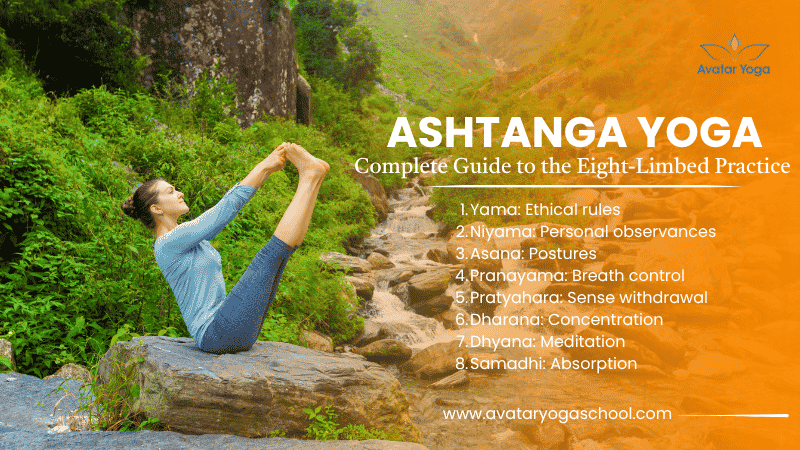
The Eight Limbs (Ashtanga)
Patanjali’s eight limbs provide a framework for living a purposeful life :
- Yama — Moral codes (non-violence, truthfulness, non-stealing, moderation, non-possessiveness)
- Niyama — Personal observances (cleanliness, contentment, discipline, self-study, surrender)
- Asana — Posture
- Pranayama — Breath control
- Pratyahara — Withdrawal of the senses
- Dharana — Concentration
- Dhyana — Meditation
- Samadhi — Absorption
The physical postures are the third limb. They prepare the body and mind for the subtler practices that follow.
What Is the Primary Series (Yoga Chikitsa)?
The Primary Series, called Yoga Chikitsa (yoga therapy), is the foundational sequence of Ashtanga Vinyasa Yoga . It consists of approximately 75 postures and typically takes 90 minutes to two hours to complete .
The series is logical and progresses toward cleansing the body, aligning the spine, and increasing strength & flexibility.
- Sun Salutations (Surya Namaskara A and B) — to warm up the body and connect breath into movement
- Postures that can be done standing — Develops stability, balance and concentration
- Postures on the Ground — Work the Core and Deepen Flexibility
- Backbends — open the chest as well as spine
- Ending Sequence — Inversions and final relaxation in Savasana
Every postures gets the body ready for the next one. The example being the standing postures create the necessary hamstring flexibility and hip rotation for seated forward bends and twists.
The Tristhana Method: Three Places of Attention
Ashtanga practice revolves around three simultaneous points of focus, known together as Tristhana :
- Asana — The posture itself
- Ujjayi Pranayama — The breath, kept smooth and audible
- Drishti — The gazing point, which directs attention inward
These three elements work together to purify the body, nervous system, and mind . The practice also involves bandhas—internal energy locks that support the breath and stabilize the core.
By keeping attention on breath, posture, and gaze, practitioners prevent the mind from wandering. This is why Ashtanga is often described as a moving meditation.
What Is Mysore Style Practice?
- Mysore style is the traditional method of practicing Ashtanga yoga . Named after the city in India where Pattabhi Jois taught, it differs significantly from a typical led class.
- In a Mysore class, students practice independently at their own pace while a teacher moves around the room offering individual guidance . Students memorize the sequence over time and practice according to their ability level. New postures are added gradually as strength and proficiency develop.
- This method allows practitioners to focus internally rather than following a teacher’s cues. It also accommodates different energy levels on different days—some days you push deeper, others you move gently, all within the same structure.
- For beginners, Mysore style may sound intimidating, but it is actually designed for gradual learning. Teachers introduce the Sun Salutations first, then add postures one at a time based on each student’s readiness.
Who Was Pattabhi Jois?
- Sri K. Pattabhi Jois (1915–2009) is widely credited as the modern founder of Ashtanga Vinyasa Yoga . He began studying yoga at age 12 and later became a student of T. Krishnamacharya, a pivotal figure in the revival of yoga in the early 20th century.
- Jois established the Ashtanga Yoga Research Institute in Mysore, India, and taught there for most of his life . A Belgian student named André Van Lysebeth wrote about Jois in a 1967 book, which brought Western students to India and sparked the global spread of Ashtanga.
- His students included celebrities like Madonna and Sting, but Jois was known for giving all students the same rigorous training regardless of fame . He authored Yoga Mala, a foundational text on the Ashtanga method.
Benefits of Ashtanga Yoga
The physical and mental benefits of Ashtanga are well-documented through practitioner experience, though individual results vary.
Physical benefits include:
- Increased core, arm and leg strength
- Greater flexibility and range of motion
- Improved cardio-respiratory endurance due to the continuous flow of movement
- Improved posture and spinal alignment
- Sweating and Improved Circulation as a Way of Detoxification
Mental and emotional benefits include:-
- Enhanced concentration and focus
- Reduced stress and tension
- Greater body awareness
- A disciplined and a habitual feel
- Meditation via breath and motion
A more regimented approach to the practice can be especially useful for individuals who thrive on predictability and quantifiable improvement.
How to Start Ashtanga Yoga as a Beginner
Starting Ashtanga does not require prior yoga experience, but the practice does ask for patience and consistency.
Practical first steps:
- Find a qualified teacher —When you learn continuously with someone who is qualified ideally, a teacher with training in the Ashtanga lineage to guide you safely and holistically through your early practice.
- Start with a led class or beginner-friendly Mysore — Led classes teach the sequence and breath. Mysore classes provide individualized instruction .
- Learn the Sun Salutations first — These are the foundation of the practice. Master them before adding more postures.
- Practice at your own pace — In Mysore style, you build the sequence gradually. There is no rush .
- Be consistent — Traditionally, Ashtanga is practiced six days per week, but beginners can start with three days and build from there .
- Rest on moon days — Many practitioners take rest on full and new moon days as part of the tradition.
What to expect in your first class:
- Your teacher may guide you through Sun Salutations and a few standing postures.
- Your first practice might last only 20–30 minutes and grow over time.
- You will likely be sore in unfamiliar places as your body adapts.
Ashtanga Yoga in Rishikesh
Rishikesh, known as the yoga capital of the world, is a major destination for Ashtanga Yoga teacher training and immersive study . Located in the Himalayan foothills along the Ganges River, the city has a long history as a center for spiritual practice.
Many yoga schools in Rishikesh offer 100-hour, 200-hour, and 500-hour teacher training programs that include Ashtanga Vinyasa, Hatha, and philosophy . These courses typically include daily asana practice, pranayama, meditation, and study of yoga texts. Accommodation and sattvic meals are often part of the package .
If you are wanting to see the traditional side of Ashtanga, an internationally recognized method of yoga, and practice in a place where yoga is part of everyday life then Rishikesh is your jam.
Common Mistakes Beginners Make
Avoiding these pitfalls can make your early Ashtanga experience more sustainable:
- Skipping the breath — Ashtanga yoga is a style of yoga that is breath-led. If you do not use ujjayi breath during the practice of postures, your meditative practice can turn into a workout.
- Comparing your progress to others — Mysore style makes comparison tempting, but every body is different. Your practice is yours.
- Pushing too hard too soon — The sequence is designed to build progressively. Skipping ahead to advanced postures before the body is ready risks injury .
- Neglecting rest and recovery — Ashtanga is vigorous. Recovery days and adequate sleep are part of the practice.
- Expecting immediate flexibility — Progress in Ashtanga is measured in months and years, not weeks.
Frequently Asked Questions
Is Ashtanga yoga suitable for beginners?
Yes, but it is best learned with a qualified teacher. Mysore style is designed to introduce postures gradually, making it accessible for beginners who are willing to start slowly .
How is Ashtanga different from Vinyasa flow?
Vinyasa flow classes often vary sequences and are teacher-led. Ashtanga follows a fixed sequence that students memorize and practice at their own pace, especially in Mysore style .
Do I need to be flexible in order to do ashtanga yoga?
Flexibility doesn’t just come from a mat; you build it by using it. This series is designed to gradually open up the body.
How many days a week should I practice Ashtanga?
The traditional recommendation is six days per week, resting on Saturdays and moon days . Beginners can start with three days and build gradually.
What does “Ashtanga” literally mean?
It means “eight limbs” in Sanskrit, referring to Patanjali’s eightfold path .
Can I practice Ashtanga Yoga at home?
Once you have learned the sequence from a teacher, home practice is possible and encouraged. Mysore style is essentially self-practice with teacher support, so the skills transfer well.
What is the goal of Ashtanga yoga?
The physical practice is a tool for purifying the body and mind, leading toward greater self-awareness and, ultimately, the deeper states of concentration and meditation described in Patanjali’s eight limbs .
Conclusion
Ashtanga yoga is a complete system of physical, mental and spiritual developement. With a more structured sequence, emphasis on breath, and traditional Mysore method—it is a practice that will deepen with you for years—not weeks. Whether it is the physical challenge, meditative rhythm that works for you or philosophical depth – there is a clear path In Ashtanga.
For those willing to try this practice in the roots of traditions, Avatar Yoga School Rishikesh provides Ashtanga Yoga Teacher Training from an authentic perspective and philosophy dedicated towards it.